
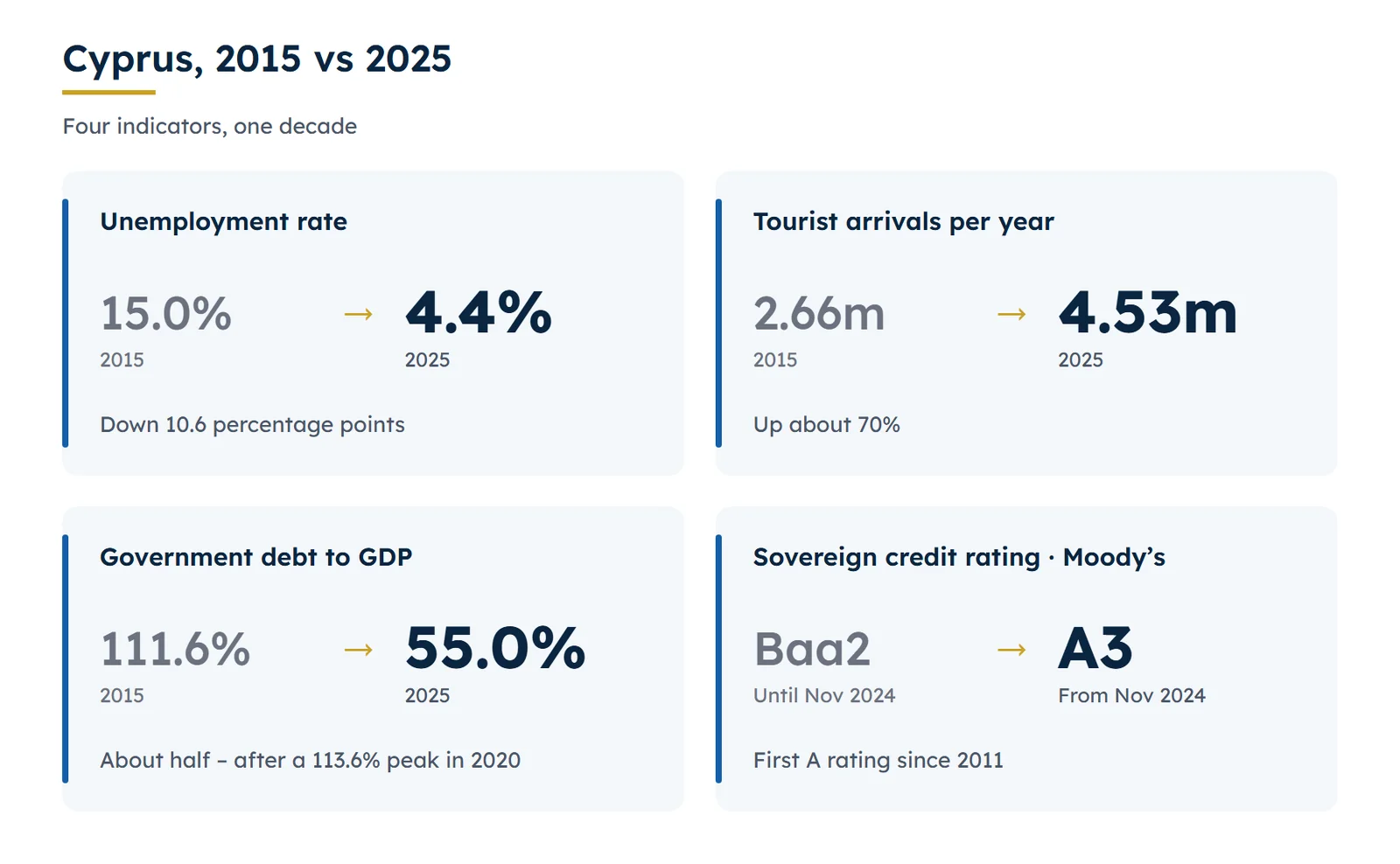
Ten years ago Cyprus was a country inside an aid programme, with 15% unemployment and public debt larger than its annual output. In 2025 unemployment was below 5%, the debt-to-GDP ratio had fallen to less than half its 2015 level, and tourism reached an all-time high.
By Global Ayalon Investments · 6 min read
In short
- According to Eurostat, unemployment in Cyprus fell from 15.0% in 2015 to 4.4% in 2025, and government debt fell from 111.6% of GDP to 55.0%. Over the same years tourist arrivals rose by 70%, to a record 4,534,073, according to the Cyprus Statistical Service.
- The road was not straight. In 2020 tourism collapsed to 631,609 arrivals and debt went back up to 113.6% of GDP, and both measures are now better than before COVID.
- In the Larnaca district, the house price index rose by 8.3% in the fourth quarter of 2025 compared with the same quarter a year earlier, according to the Central Bank of Cyprus. The figure points to real activity in the property market, which may also mean higher entry prices.
The starting point
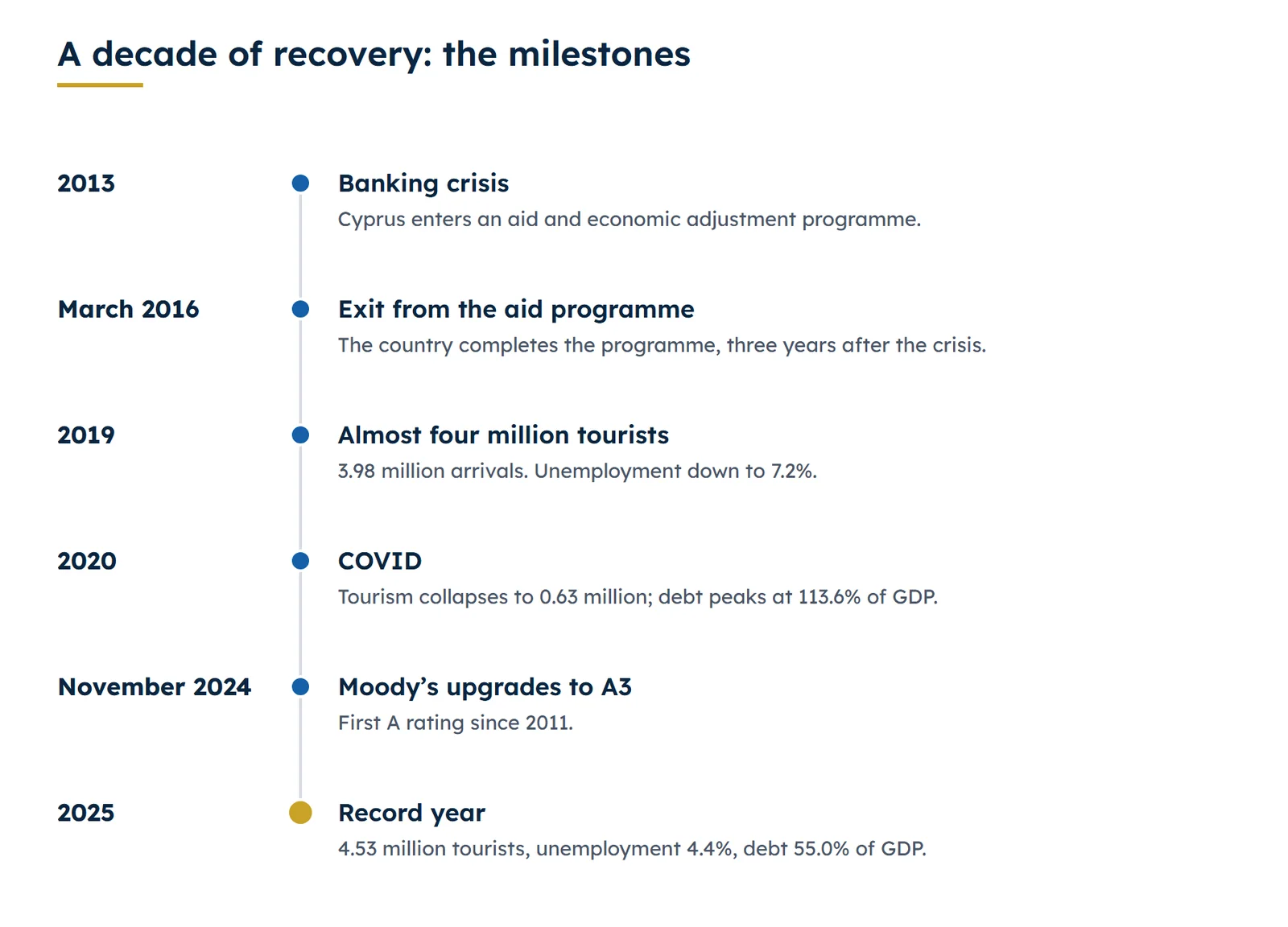
For many of us, the Cyprus banking crisis of 2013 still raises concerns. The crisis led the country into an economic adjustment programme and European financial assistance, and the damage to the labour market lasted for years. Unemployment stood at 15.9% in 2013 and rose to 16.1% in 2014. Almost one in six people in the labour force was looking for work.
In 2015 the numbers began to move, slowly. Unemployment fell to 15.0%, and government debt stood at 111.6% of GDP, slightly below the previous year’s 113.5%. In March 2016 Cyprus exited the aid programme, according to the European Commission. That is the starting point of the decade, and anyone who knows Cyprus only from that moment is holding a picture that is ten years old.
What changed over the decade
Unemployment fell almost without a break: 13.0% in 2016, 11.1% in 2017, 8.4% in 2018 and 7.2% in 2019. After a slight rise to 7.6% in 2020 the decline continued, reaching 4.4% in 2025. Within a decade unemployment fell by more than 10 percentage points, to less than a third of where it started.
The debt-to-GDP ratio fell from 111.6% in 2015 to 92.3% in 2019, jumped back to 113.6% in 2020, then fell to 80.1% in 2022, 62.7% in 2024 and 55.0% in 2025. A country whose debt once exceeded its annual output now carries debt of a little more than half of it.
On 22 November 2024 Moody’s raised Cyprus’s credit rating from Baa2 to A3, the country’s first A-grade rating from the agency since 2011. The rating covers the country as a whole, and Moody’s now sees Cyprus as a country that has come through the crisis.
2025 itself was covered in detail in our earlier article. GDP grew by 3.8% that year, according to the Cyprus Statistical Service.
Tourism: growth, collapse, record
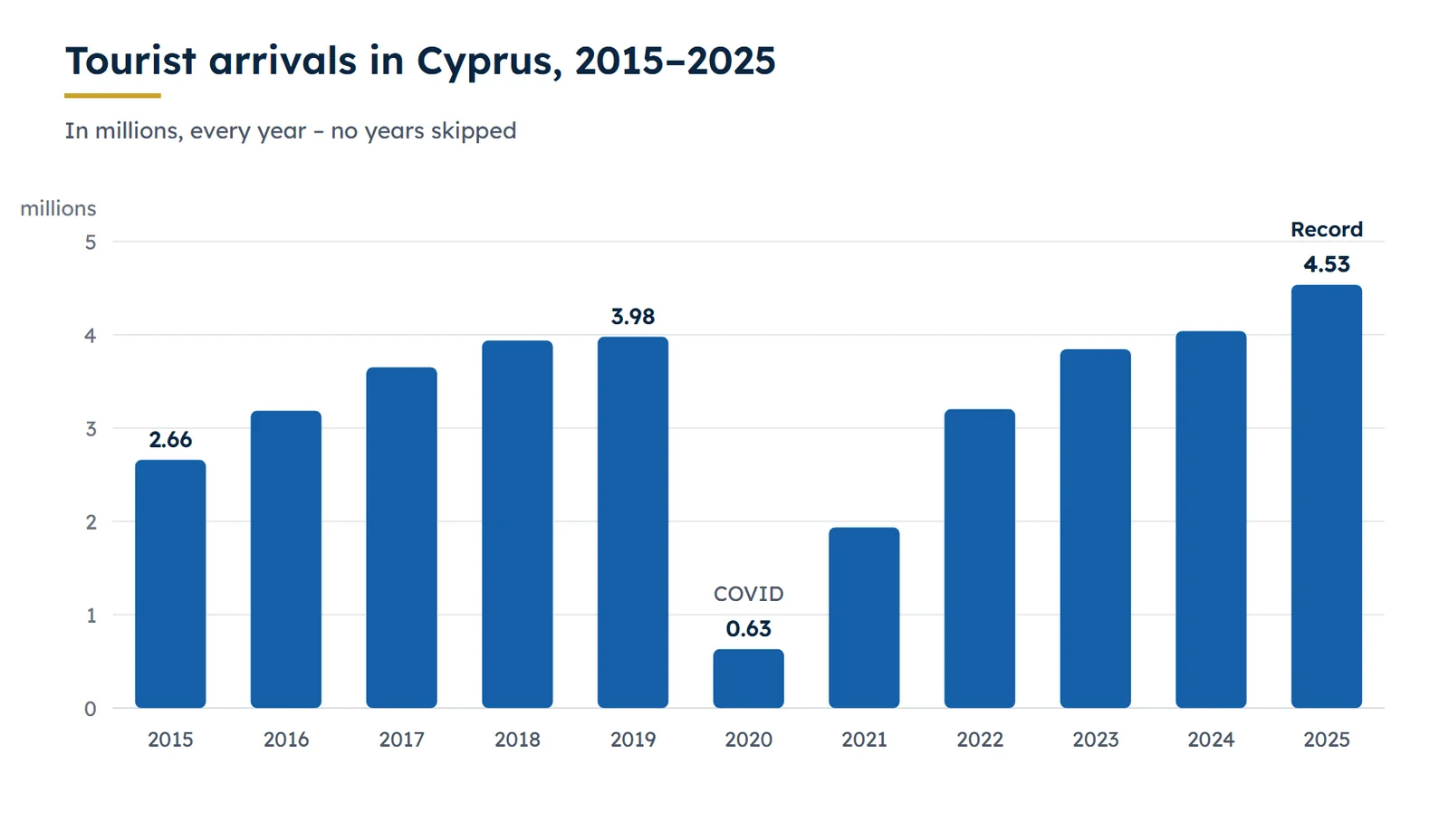
In 2015, 2,659,405 tourists arrived on the island. The number rose in each of the next four years, to 3,938,625 in 2018 and 3,976,777 in 2019, very close to four million.
Then came 2020. Arrivals collapsed to 631,609, less than a sixth of the year before.
The recovery took time: 1,936,931 arrivals in 2021, 3,201,080 in 2022, 3,845,652 in 2023. In 2024 the island passed the four-million mark, with 4,040,200 arrivals, and 2025 set an all-time record: 4,534,073 tourists, about 14% above 2019 and 70% above 2015. The gap between the low and the high is almost four million people a year, more than sevenfold.
One 2020 figure deserves a second reading. In the year tourism lost more than 80% of its arrivals, unemployment rose from 7.2% to 7.6%. The economy that emerged from the 2013 crisis absorbed the 2020 shock without going back to where it started.
What about Larnaca?
The figures so far cover Cyprus as a whole. Larnaca’s port, airport and tourism are covered in a separate article. Three of its figures bear repeating here.
According to Hermes Airports, Phase 2 works at the Larnaca and Paphos airports, an investment of more than €170 million, will raise Larnaca’s capacity to 12.4 million passengers a year. The house price index in the Larnaca district rose by 8.3% in the fourth quarter of 2025 compared with the same quarter of 2024, against 9.9% in Limassol and 1% in Nicosia. The Central Bank of Cyprus report, based on Department of Lands and Surveys data, counts 1,109 sales contracts signed in the district that quarter: 51% of buyers were local, 16% from the European Union and 33% from outside it.
About half of Larnaca’s buyers are local and about half are foreign, between Nicosia, where 84% of buyers are local, and Paphos, where only 32% are.
What the data says, and what still needs checking
Unemployment, debt and tourism are national figures, and they describe 2015 to 2025. They say nothing direct about a particular apartment or about demand in Larnaca. What they show is a decade of falling unemployment, falling debt and rising arrivals.
The 8.3% rise in Larnaca points to demand, and it may also raise the entry price and narrow the margin left for a buyer coming in now.
A buyer therefore still needs three checks on the specific property. The first is location and price, against competing supply in the same area. The second is the state of construction and the rights in the property. The third is costs and taxation, which set the real price of the deal. In 2015 the question about Cyprus was whether it would come out of the crisis. By 2025 the question for a buyer had become where in Cyprus, and at what price.
Global Ayalon Investments is an Israeli family company that initiates and builds residential projects in Larnaca, among them Palm Residence and Nova – Lane Residence. In our projects you work directly with the company that initiates and builds, with guidance from the first introductory call through to handover.
Talk to us about the new projects in Larnaca →
Sources
- Eurostat
- Cyprus Statistical Service
- Moody’s
- European Commission
- Hermes Airports
- Central Bank of Cyprus
- Cover image: photo by Hert Niks, courtesy of pexels.com, used under the free Pexels licence.
The information in this article is general only and does not constitute legal, tax or investment advice, nor a commitment to any return. National data and price indices describe the past and are not a forecast for any particular property. Investing in real estate involves risk, and before any decision it is worth consulting qualified professionals.