
A new European energy standard is drawing a line through housing across the continent: the homes on one side of it are fine, while the homes on the other have a renovation bill waiting for them. It is worth knowing which side you are buying on.
- The EU’s new energy rules put Europe’s least efficient homes squarely in their sights. All 27 member states were late to adopt them, but the direction is already settled.
- In Cyprus, every new building has had to meet a strict energy standard since the end of 2020, while a large share of the island’s older apartments were built before there was any insulation requirement at all.
- For a buyer in Larnaca, that is precisely the practical difference between an apartment that already meets the standard and one that may drag a renovation along with it.
On 15 July 2026 the European Commission did something it almost never does: it opened legal proceedings against all 27 member states, on the same day and for the same reason. Not one of them had turned the new building-energy rules into national law by the deadline (European Commission).
At first glance this reads as just another bureaucratic story, and to some extent it is. Even so, the delay concerns the timetable alone and not the direction things are heading. Buildings consume more energy than anything else in Europe, and the rules that all 27 governments are late in adopting are the ones that will determine what happens to the worst offenders among them. For anyone weighing the purchase of an apartment in Cyprus, that is effectively the whole story in miniature, because it is exactly what separates an older second-hand apartment from a newly built one.
What the new rules require
It is worth being clear first about what these rules do not do: they do not wipe out the value of older buildings by decree. What they do is oblige each country to improve its worst-performing buildings, on a defined timetable.
For residential property, the target is set across the entire national stock: average energy consumption must fall by at least 16% by 2030, and most of that reduction has to come from the worst-performing 43% of buildings.
That last figure is worth reading twice, because it means close to half of Europe’s homes are exactly what the new rules were written to fix.
What the banks make of it
A rumour has been circulating among investors lately, claiming that European banks are about to cut 15% to 25% automatically from the appraised value of any older property. The rumour is not true, and it is worth saying so plainly, because it has already deterred people from decisions there was no sense in avoiding.
What actually changed is far quieter. Since January 2025, European banks have valued real estate collateral under a new set of capital rules known as CRR3. Those rules replaced open market value with a more conservative “property value” and limited a bank’s ability to revise a valuation upward beyond the multi-year average of recent years. There is one notable exception to that rule: permanent improvements that unequivocally raise a property’s value can indeed break through the ceiling, and energy efficiency improvements are named there explicitly.
It follows that the whole mechanism works upward rather than downward. There is no European rule instructing a bank to reduce the value of an older apartment simply because it is old.
What is fair to say is more nuanced: energy performance has moved from a footnote in the valuation file to something the bank genuinely looks at. A property facing a renovation obligation is a property carrying a future cost, and banks tend to price costs like that. There is no haircut here, but there is a question you can expect to be asked from now on. For us it forms part of the banking support we provide to buyers.
France, where it is already happening
France offers the clearest preview, simply because it moved first. Under French climate legislation, a home rated G on the national energy scale can no longer be let on a new lease, and that has been the case since January 2025. Class F follows in 2028 and class E in 2034. Roughly 5.2 million homes in France fall within that range (French government).
The practical meaning is clear: an apartment does not lose its walls when the rules change, it loses its future tenants. The asset still stands where it was, but the income from it no longer does.
On sale prices, by contrast, the effect is far slower and milder than the alarmed version suggests. A poorly rated home typically trades a few percent below a comparable property with an average rating, and in certain markets the gaps run wider.
Cyprus: the sun-drenched corner of the Union
This is where Cyprus enters the picture, and where all of this becomes genuinely interesting, because the island has an unusually direct connection to the question of energy.
Cyprus is the warmest country in the European Union, with some three hundred days of sunshine a year and a long, hot summer. That sun is first and foremost an asset: it is why people move to live on the island, and thanks to it solar water heaters and photovoltaic panels have been an ordinary sight on Cypriot rooftops for decades. At the same time, it also means that a building’s performance is felt in practice rather than remaining theoretical. In Cyprus, cooling is the load that counts, and the way a home was built shows up on the electricity bill every summer, in a way it simply does not in Berlin or Paris.
For most of its modern history, Cyprus also imported its fuel. That picture, however, is now changing before our eyes: since 2011, between 15 and 18 trillion cubic feet of natural gas have been located in Cypriot waters, in the Aphrodite, Calypso, Cronos, Zeus, Glaucus and Pegasus fields, with the exploration and production licences held by ExxonMobil, QatarEnergy, Eni, TotalEnergies, Chevron and Shell. First gas from Cronos is estimated for late 2027, with volumes expected to grow in the years that follow. You can read more about it in our post on the Cronos gas field.
None of it is flowing yet, and even so what has already changed is the direction of travel: an island that was an energy importer is positioning itself as a distinctive supply point in southern Europe.
The part that affects you directly
Cyprus, too, drew a line of its own across the housing question. Minimum energy requirements, including a mandatory insulation standard, came into force in 2007 and applied to planning applications submitted after 21 December of that year. Since 2010, every building constructed, sold or let on the island requires an energy performance certificate, graded A to H and valid for ten years (Cyprus Ministry of Energy).
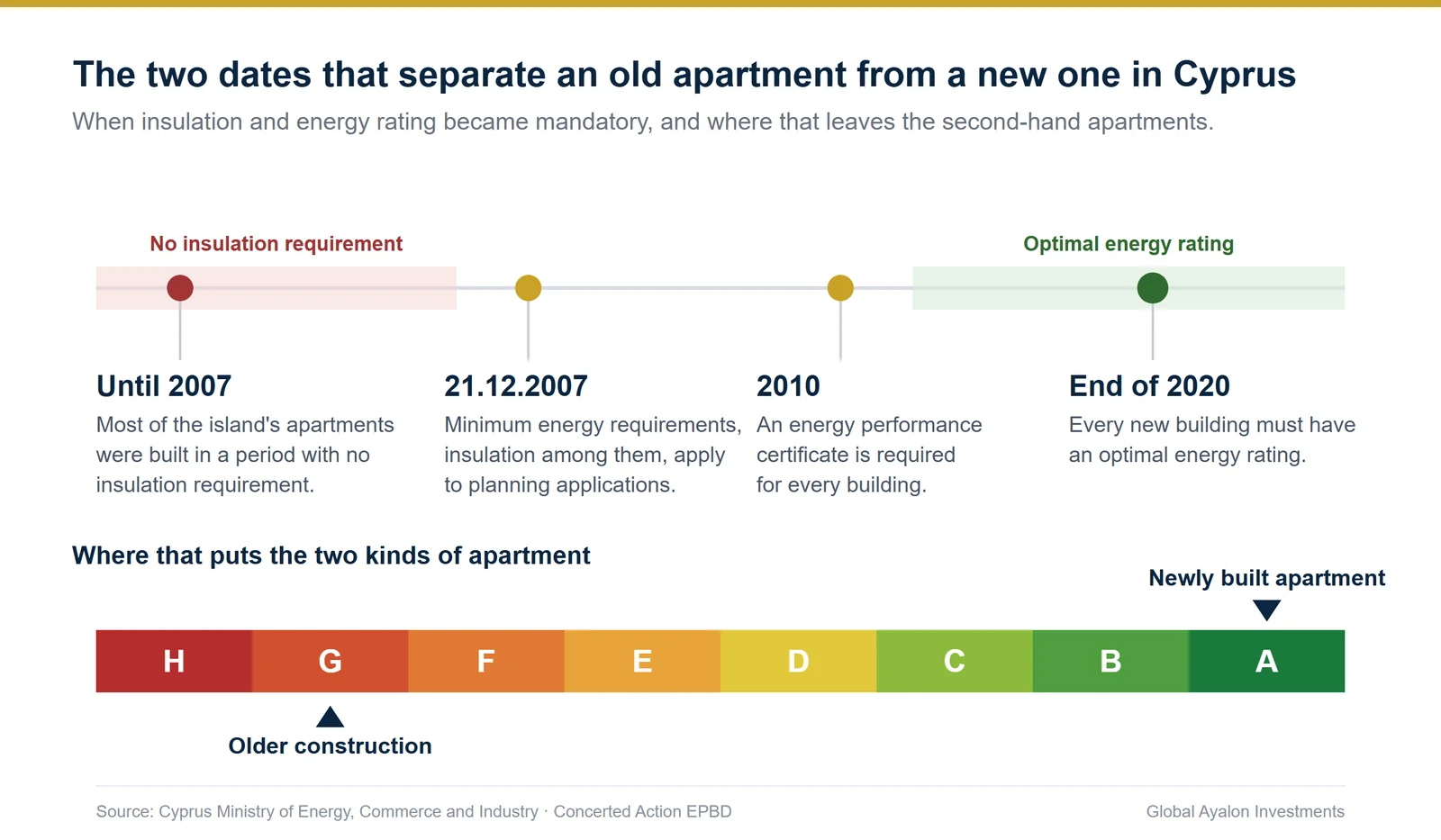
Everything built before that line was of course built without the obligation, and a considerable share of the island’s second-hand apartments are older than it: single glazing, little insulation or none at all, and a design based on an underestimate of the cooling load. These are precisely the apartments that reach the market in the lower grades.
So when a pleasant second-hand apartment in a 1990s building is offered at a comfortable price, below new construction, it is priced that way for a good reason. The discount is not a bargain but a renovation bill waiting for the right person.
What new construction in Cyprus already has to be
Since the end of 2020, every new building on the island must be a nearly-zero-energy building. This is not a marketing badge but the building code itself, and there are real numbers behind it: insulation values, ceilings on heating demand and energy consumption, and a mandatory minimum from renewable sources. That is why, in a newly built apartment in Cyprus, insulation, high-performance glazing, solar hot water and photovoltaic systems arrive as standard rather than as an upgrade you pay for separately. Destiny Residence and Nova – Lane Residence are built this way, and you can see it across all of our projects in Larnaca.
For a buyer, the significance is quiet but not small. A new Cypriot home, in Larnaca or anywhere else on the island, is not waiting on a transposition deadline, a national renovation trajectory or a minimum threshold the government there has yet to define, and it therefore already sits on the right side of the very line the rest of Europe is currently litigating in court. It is also cheaper to run, in a climate where cooling is the dominant expense. And when the second-hand market is eventually sorted into energy-compliant and non-compliant, as has already happened in the French rental market, it will find itself in the higher classification by construction rather than by renovation.
Put differently: while Europe devotes this decade to deciding what a building has to be, in Cyprus they already started building that way in 2021.
Frequently asked questions
Are European banks automatically reducing the value of older apartments?
No. There is no European rule instructing a bank to reduce a property’s value on account of its age. What changed in January 2025 is that banks value collateral under the CRR3 capital rules, which are more conservative about revising valuations upward. The claim of an automatic 15% to 25% cut on older properties is not true.
Will the new rules require me to renovate an apartment in Cyprus?
Not directly, and not at this stage. The rules set national targets rather than obligations on individual owners, and each country decides how to meet them. Cyprus, like the other 26 member states, has yet to complete the legislation that will set its own terms. The pressure is directed at the least efficient part of the housing inventory, which in practice means older buildings with a low energy rating.
What energy rating does a newly built apartment in Cyprus have?
Since the end of 2020, every new building in Cyprus must be a nearly-zero-energy building under the national building code. That means defined insulation values, ceilings on heating demand and energy consumption, and a mandatory minimum of energy from renewable sources. It is a legal requirement, not an optional upgrade.
Talk to us about new-build opportunities in Larnaca →
- European Commission — infringement proceedings opened against all 27 member states, 15 July 2026, concerning the recast Energy Performance of Buildings Directive (EU) 2024/1275. Transposition deadline: 29 May 2026. energy.ec.europa.eu
- French government — Service-Public, the calendar of rental prohibitions by energy rating under the Climate and Resilience Law: class G from January 2025, F from 2028, E from 2034. service-public.gouv.fr
- Cyprus Ministry of Energy, Commerce and Industry — energy performance of buildings: the A–H certificate regime in force since 2010, and the nearly-zero-energy requirement for every new building from 31 December 2020. meci.gov.cy
This article is general information on regulatory developments and does not constitute legal, tax or investment advice. The timetables described here depend on transposition into national law and may change. Global Ayalon Investments accompanies buyers through legal, banking and immigration matters with professionals in each field.