
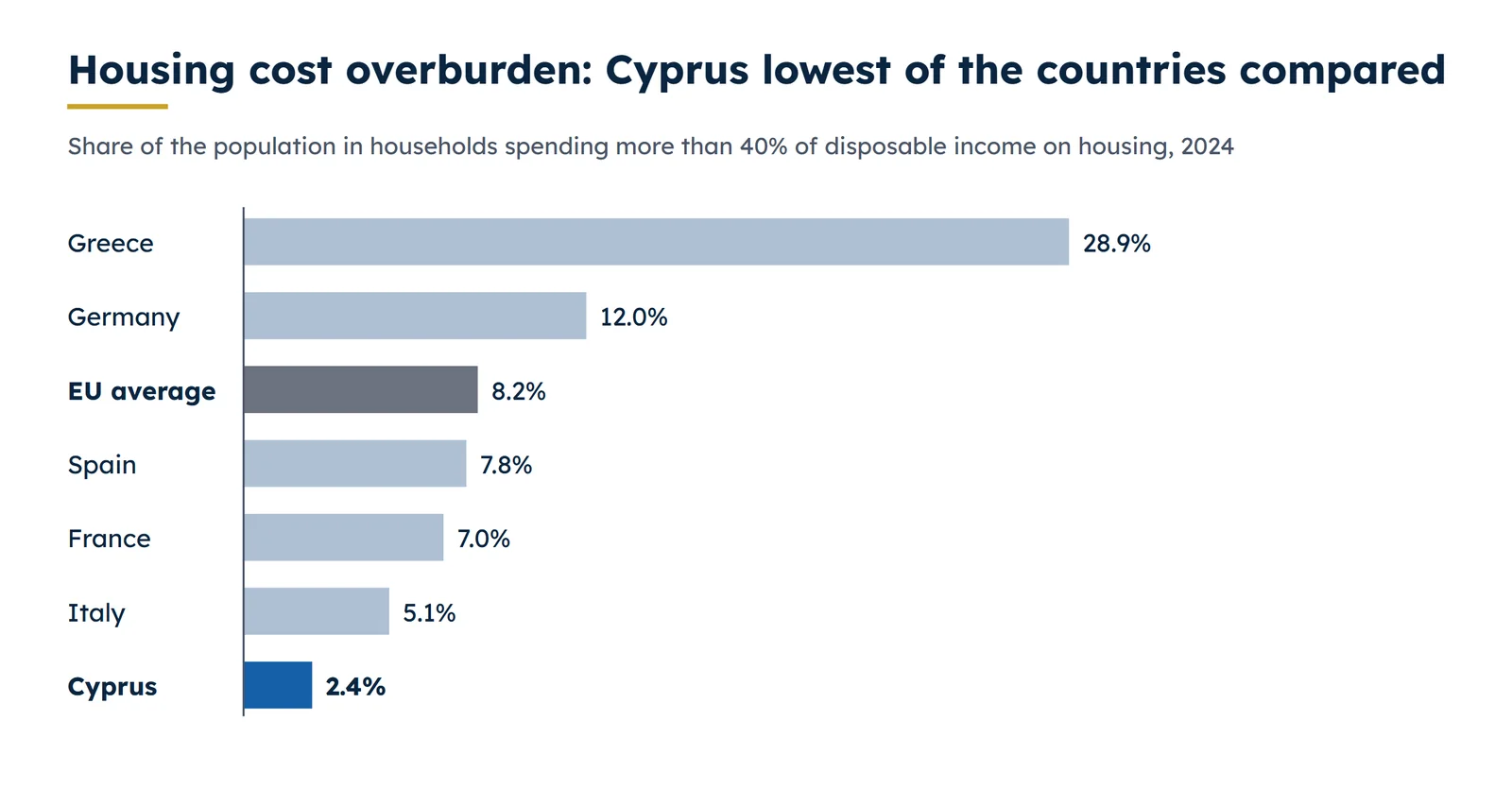
If you move to Cyprus, you will find a price level about 5% below the EU average and an income whose purchasing power is above the average. Only 2.4% of residents spend more than 40% of their income on housing, compared with 8.2% across the EU and 12.0% in Germany. On the other hand, Cyprus is not yet in Schengen, and the healthcare system has waiting lists. The official data follows on income, education, healthcare, prices and safety.
By Global Ayalon Investments · 9 min read
Summary
- Prices and income: the price level in Cyprus is about 5% below the EU average and about 13% below Germany, and in purchasing power median income is about 7% above the EU average, although in euros it is slightly below it.
- Housing: only 2.4% of residents spend more than 40% of their income on housing, against 8.2% across the EU and 28.9% in Greece.
- Education and healthcare: 60.3% of 25 to 34 year olds hold a tertiary qualification, against 43.9% in the EU, and life expectancy is 83.5 years against 81.5. However, early childhood enrolment is below average (86.7%, compared with 94.6%), and the healthcare system has waiting lists.
- Status and climate: Cyprus is a member of the EU and the euro area, accession to Schengen is expected during 2027, and the island has about six hours of sunshine a day even in December.
How much do people earn in Cyprus, and how heavy is the cost of housing?
To compare incomes across countries, Eurostat, the EU’s statistics agency, does not look at salaries. It takes everything a household receives after tax, including benefits, and shares it among the household’s members by weight, because a family shares rent, a car and a kitchen: the first adult counts as 1, each additional adult as 0.5 and each child under 14 as 0.3. A couple with two young children therefore counts as 2.1. The second adjustment is purchasing power: the same sum buys more in a cheaper country and less in an expensive one, so incomes are also translated into what they can actually buy.
On this basis, the median net income of a couple with two young children in Cyprus is about €43,400 a year, or about €3,600 a month (2024). The EU average is about €45,300, Germany about €58,000, France about €53,700, Italy about €43,300, Spain about €40,500 and Greece about €22,800. In euros, Cyprus is slightly below the average, but prices there are lower, so in purchasing power its income is about 7% above the EU average. Between 2023 and 2024, income in Cyprus rose by about 7%.
Cyprus also has a lower share of residents spending more than 40% of their income on housing than other southern European countries: the rate is 7.8% in Spain and 5.1% in Italy, while in Cyprus it fell from 2.6% in 2023 to 2.4%. We have written separately about the economy over the past decade: Cyprus: From a Decade of Recovery to a Decade of Opportunity.
Is Cyprus part of Schengen?
Not yet. According to the official EU website, Cyprus has been an EU member since 1 May 2004 and part of the euro area since 1 January 2008, but it is not in the Schengen area. The European Commission describes it as in the process of joining and taking part in Schengen cooperation, but the Council has yet to lift internal border controls. Accession is expected during 2027.
According to Your Europe, EU citizens may stay in another member state for up to three months without registering, and for a longer stay they may need to register, which in Cyprus means the Civil Registry and Migration Department. That rule applies to EU citizens. Citizens of non-EU countries need a residence permit, and one route to it is permanent residence based on investment. Under Regulation 6(2) of the Aliens and Immigration Regulations, as revised in 2023, the main conditions are an investment of at least €300,000, excluding VAT, in a new residential property, and a secured annual income of €50,000 for the main applicant, plus €15,000 for a spouse and €10,000 for each child.
What are the weather and the sea like in Cyprus?
The summer is long and dry, and the winter is mild. According to the Cyprus Deputy Ministry of Tourism, summer runs from mid-May to mid-October and winter from December to February. The island has about six hours of bright sunshine a day even in December and January, and an average of 11.5 hours a day over the six summer months. In July and August the daytime temperature is about 30 degrees Celsius on the central plain and about 24 in the Troodos mountains, and in January it is about 10 degrees on the plain.
The sea temperature is above 22 degrees from June to November, reaches 27 in August and is 16 to 17 between January and March. According to the European Environment Agency, all coastal bathing waters in Cyprus were rated excellent in the 2025 bathing season, as were those in Lithuania and Slovenia. In Cyprus, Greece, Bulgaria and Austria more than 95% of all bathing sites were excellent, compared with 85% of the 22,010 designated sites across the EU.
Who lives in Cyprus?
According to the 1 October 2021 census of the Cyprus Statistical Service, 77.9% of residents are Cypriots, 10.1% are citizens of other EU countries (93,540 people) and 11.6% are citizens of non-EU countries (107,168). In total, 923,381 residents were counted across the island’s districts.
4.7% of residents are Greek citizens, 2.2% Romanian and 1.8% Bulgarian. Outside the EU, the largest groups are the United Kingdom (2.0%), Syria (1.4%) and Russia (1.3%). By country of birth, 74.6% of residents were born in Cyprus, 9.3% in other EU countries and 15.4% outside the EU, including the United Kingdom (3.0%), Russia (1.8%) and Syria (1.3%). More than one in four residents was born outside the island. As for age, 15.4% of residents are under 15 and 17.2% are 65 or older.
Where do people live in Cyprus?
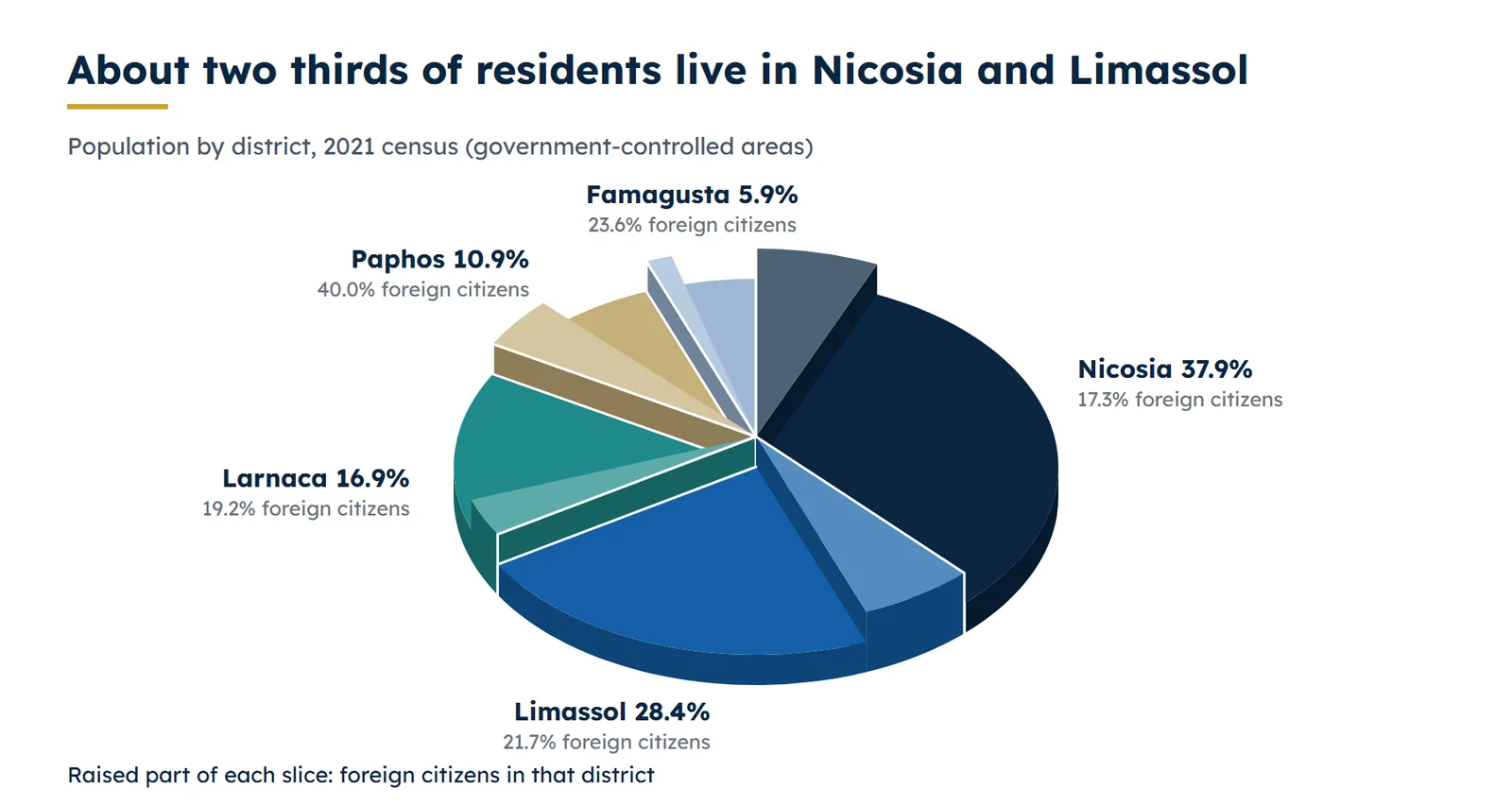
Two thirds of residents live in cities, and the districts differ greatly in size, pace of growth and share of foreign residents. 66.7% of residents live in urban areas and 33.3% in rural areas. Nicosia has 350,035 residents (37.9%), Limassol 262,157 (28.4%), Larnaca 155,765 (16.9%), Paphos 101,106 (10.9%) and Famagusta 54,318 (5.9%).
Between 2011 and 2021 the population grew by 9.9% nationwide: by 16.5% in Famagusta, 14.5% in Paphos, 11.4% in Limassol, 8.8% in Larnaca and 7.1% in Nicosia. The share of foreign citizens also varies from district to district: 40.0% in Paphos, 23.6% in Famagusta, 21.7% in Limassol, 19.2% in Larnaca and 17.3% in Nicosia. We have written separately about Larnaca: Larnaca – The City Being Rebuilt.
What is the education system like in Cyprus?
Young adults in Cyprus are better educated than the European average, while early childhood enrolment is below it. In 2024, 60.3% of 25 to 34 year olds held a tertiary qualification, compared with 43.9% for the EU27 average, 53.1% in France, 52.6% in Spain, 44.5% in Greece, 39.1% in Germany and 31.6% in Italy. In 2023 the figure for Cyprus was 61.7%, so 2024 is in line with the year before. 27.6% of those aged 15 and over hold a university degree, up from 20.2% in 2011.
In 2023, 86.7% of children from age 3 up to the start of compulsory primary education were enrolled in early education, compared with 94.6% for the EU27 average, 95.3% in Germany, 100.0% in France, 97.7% in Spain and 93.5% in Italy. In 2022 the figure for Cyprus was 84.6%. The data does not explain the gap.
According to Eurydice, a European Commission network, private kindergartens and schools in Cyprus are registered with the Ministry of Education, Sport and Youth. The ministry supervises them, approves their curricula and must approve tuition fees in advance. We have no official figure for the number of institutions teaching in English or following the IB programme, so check each school’s curriculum and licence directly.
How does the healthcare system work in Cyprus?
The national health system in Cyprus is called GeSY (short for General Healthcare System, the state health insurance scheme). Entitlement is broad, and access in practice depends on the queue. According to the European Observatory on Health Systems and Policies, entitlement is determined by legal residence and not by citizenship, income or insurance contributions, and more than 90% of the population is registered as beneficiaries. The same report notes waiting lists for doctor visits and elective surgery, and 32% of the beneficiaries surveyed named waiting times as the system’s main weakness.
Life expectancy at birth in 2024 was 83.5 years in Cyprus, against 81.5 for the EU average, 81.2 in Germany, 81.9 in Greece, 83.0 in France, 83.7 in Italy and 84.0 in Spain.
What does it cost to live in Cyprus?
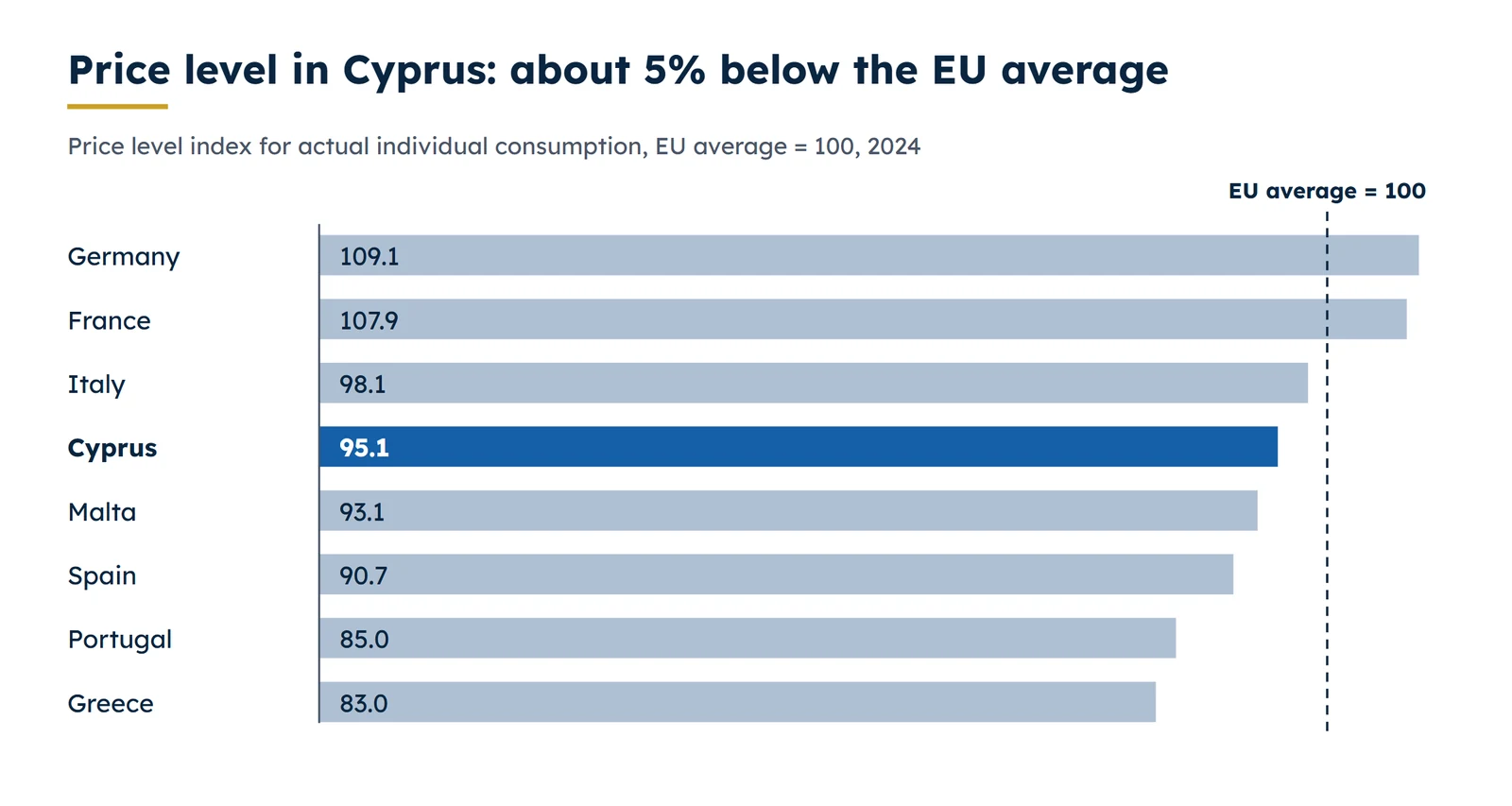
The price level in Cyprus is about 5% below the European average. The price level index for actual individual consumption of households stood at 95.1 in 2024, with the EU average at 100, which is about 13% below Germany (109.1). France (107.9) and Italy (98.1) are more expensive than Cyprus. Spain (90.7), Portugal (85.0) and Greece (83.0) are cheaper, and so is Malta (93.1), which is similar in size.
The index covers current household consumption, and apartment prices and rents are not part of it. The gap is stable: between 2022 and 2024 the index for Cyprus was 95.4, 95.1 and 95.1, and for Germany 108.9, 109.0 and 109.1. We have written about the Cypriot economy in The Island That Keeps Growing.
Is Cyprus safe?
On crime, Cyprus is close to the European average. In 2023, 9.6% of residents reported crime, violence or vandalism in their area, against 10.0% for the EU average, 10.7% in Germany, 14.7% in France and 20.9% in Greece. In households with dependent children the rate was 9.9% in Cyprus and 9.8% in the EU.
On serious crime the gap is clearer. In 2024 police in Cyprus recorded about 118 cases of robbery, burglary and sexual offences per 100,000 residents, against about 463 in Spain, 474 in Germany and 668 in France, roughly a quarter of the German rate. The figures are also affected by each country’s laws and recording practices, so they give a rough direction.
How many passengers pass through Cyprus’s airports?
Passenger numbers broke a record in 2025. According to Hermes Airports, Larnaca and Paphos airports handled 13.75 million passengers that year, up 12% on 2024: 9.91 million in Larnaca (up 14%) and 3.84 million in Paphos (up 5%). The airports serve 60 airlines, 160 routes and 41 markets, and the countries that send the most passengers are the United Kingdom, Greece, Israel, Poland and Germany. The months outside peak season grew by 15% to 18%.
The figure includes tourists, but the same 160 routes serve residents flying to Israel or elsewhere in Europe. We have written about tourism in Cyprus over the past decade in Cyprus: From a Decade of Recovery to a Decade of Opportunity.
Cyprus versus the EU average in numbers
| Indicator | Year | Cyprus | EU average |
|---|---|---|---|
| Median net income, couple with two young children, € a year | 2024 | 43,400 | 45,300 |
| Residents spending more than 40% of income on housing | 2024 | 2.4% | 8.2% |
| 25 to 34 year olds with tertiary education | 2024 | 60.3% | 43.9% |
| Life expectancy at birth (years) | 2024 | 83.5 | 81.5 |
| Children from age 3 in education | 2023 | 86.7% | 94.6% |
| Price level (EU = 100) | 2024 | 95.1 | 100 |
| Reported crime, violence or vandalism in the area | 2023 | 9.6% | 10.0% |
| Bathing sites rated excellent | 2025 | more than 95% | 85% |
The table does not show that Cyprus is not yet in Schengen and that the healthcare system has waiting lists.
Questions and answers
Is Cyprus in the Schengen area?
Not yet. It takes part in Schengen cooperation, but internal border controls have not yet been lifted, and accession is expected during 2027.
Is life in Cyprus cheap?
Compared with Germany and France, yes, and compared with Spain, Portugal and Greece, no. In 2024 the price level in Cyprus was about 5% below the European average. Apartment prices and rents are not part of the index.
Does entitlement to the healthcare system depend on Cypriot citizenship?
No. Entitlement to GeSY, the Cypriot state health insurance scheme, is determined by legal residence.
Global Ayalon Investments is an Israeli family company that has developed residential projects in Larnaca, including Palm Residence and Nova – Lane Residence. The company guides buyers and investors from Israel and abroad from A to Z, and also offers advice on immigration law.
Sources
- European Union
- European Commission
- Your Europe
- Cyprus Deputy Ministry of Tourism
- European Environment Agency
- Cyprus Statistical Service
- Eurostat
- Eurydice
- Cyprus Ministry of Education, Sport and Youth
- European Observatory on Health Systems and Policies
- Hermes Airports
The information in this article is general only and does not constitute legal advice, tax advice or investment advice, nor a commitment to any return. National figures and comparative indicators describe the past and are not a forecast for any particular family, city or property. Moving to another country and buying property involve significant decisions, and before making any decision you should consult qualified professionals.